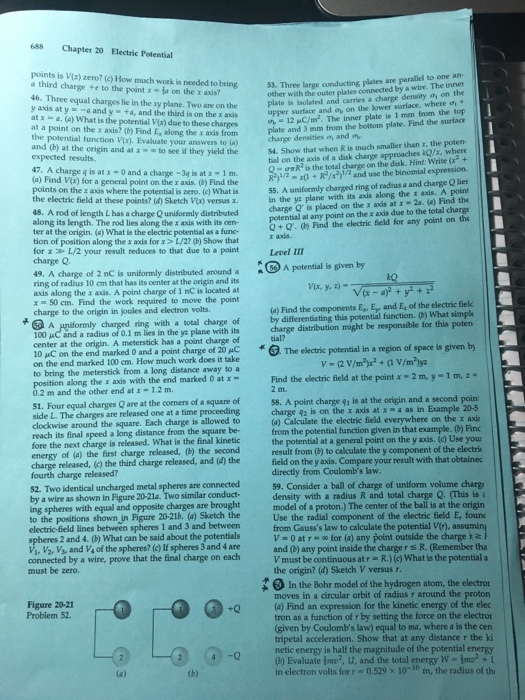
688 Chapter 20 Electric Potential points is V(x) zero? (c) How much work is needed to brin a third charge te to the point x ja on the x axis? 53. Three large conducting plates are paralled to one a other with the outer plates connected by a wire. The inner plate is isolated and carries a charge density o on the upper surface and ob on the lower surface, where yaxis at y -aand y =+a, and the third is on the x axis at x – a. (4) What is the potential V(x) due to these charges at a point on the x axis? (b) Find E, along the x axis from the potential function V(x). Evaluate your answers to (a) and (b) at the origin and at xs to see if they yield the 12 C/m2. The inner plate is 1 mm from the top plate and 3 mm from the bottom plate. Find the surface charge S4. Show that when R is much smaller than z, the poten tial on the axis of a disk charge approaches iQ/x, where results. R-OTR2 is the total chargeon the dask. Hint Write r”)1/2-x(i + R2/r2)1/2 and use the binomial expression. forsat r-oanda charge-3g is at 1-1m points on the x axis where the potential is zero. (c) What is the electric field at these points? (4) Sketch Vix) versus x. s. A rod of length L has a charge Q uniformly distributed along its length. The rod lies along the x axis with its cen- ter at the origin. (a) What is the electric potential as a func- tion of position along the x axis for x> L/27 (b) Show that for x L/2 your result reduces to that due to a point 55. A uniformly charged ring of radius a and charge Q lies inthe yz plane with its axis along the x axis. A point charge Q, is placed on the x axis at x-2a. (a) Find the potential at any point on the x axds due to the total charge Q+Q.) Find the electric Beld for any point on the Level 49. A charge of 2 nC is uniformly distributed around a ring of radius 10 cm that has its center at the origin and its axis along the x axis. A point charge of 1 nC is x_50㎝. Find the work required to move the point charge to the origin in joules and electron volts (a) Find the components E, E and E of the electric fiek by differentiating this potential function.。) What simpl charge distribution might be responsible for this poten charged ring with a total charge of 100 C and a radius of 0.1 m lies in the ya plane with its the origin. A meterstick has a point charge of center at the end marked t and a point charge of 20 μ… The electric potential in a regon of space is given by on the end marked 100 em. How much work does it take to bring the meterstick from a long distance away to a ition along the x axis with the end marked 0 at x- Find the electric field at the point x-2m, y- 1 m, z- 2 m and the other end at x 1.2 m. 51. Four equal charges Q are at the corners of a square of side L. The charges are released one at a time clockwise around the square. Each charge is allowed to reach its final speed a long distance from the square be- fore the next charge is released. What is the final kinetic energy of (a) the first charge released, the second charge released, (c) the third charge released, and (4) the 58. A point charge q, is at the origin and a second poin charge 42 is on the x axis at x-a as in Eample 20-5 (a) Calculate the electric field everywhere on the x axie from the potential function given in that example. (b) Finc the potential at a general point on the y axis. (c) Use you result from (b) to calculate the y component of the electric field on the y axis. Compare your result with that obtainec directly from Coulomb’s law 59. Consider a ball of charge of uniform volume charg density with a radius R and total charge Q. (This model of a proton.) The center of the ball is at the origin Use the radial component of the electric field E, fourn from Gauss’s law to calculate the potential Vir) V-0 atr o for (a) any point outside the charge z and (b) any point inside the charge r s R. (Remember tha V must be continuous at r R.) (c) what is the potential a the origin? (4) Sketch V versus r 52. Two identical uncharged metal spheres are by a wire as shown in Figure 20-2la. Two similar conduct- ing spheres with equal and opposite charges are brought to the positions shown in Figure 20-21b. (4) Sketch the electric-field lines between spheres 1 and 3 and betweern 2 and 4. (b) What can be said about the potentials Vi. V2, Vs and V4 of the spheres? (c) If spheres 3 and 4 are connected by a wire, prove that the final charge on each In the Bohr model of the hydrogen atom, the electro moves in a circular orbit of radius r around the proton (a) Find an expression for the kinetic energy of the elec tron as a function of r by setting the force on the electron given by Coulomb’s law) equal to ma, where a is the cen tripetal acceleration. Show that at any distance r the ki e 20-21 +Q (C) Evaluate Im2, u, and the total energy W 2L in electron volts for r ” 0.529 × 10 m, the radius of th
ScholarMatic: Explanation & Answer
Your ready answer from a verified tutor is just a click away for as little as $14.99


Click Order Now to get 100% Original Answer Customized to your instructions!