Calculus HELP!
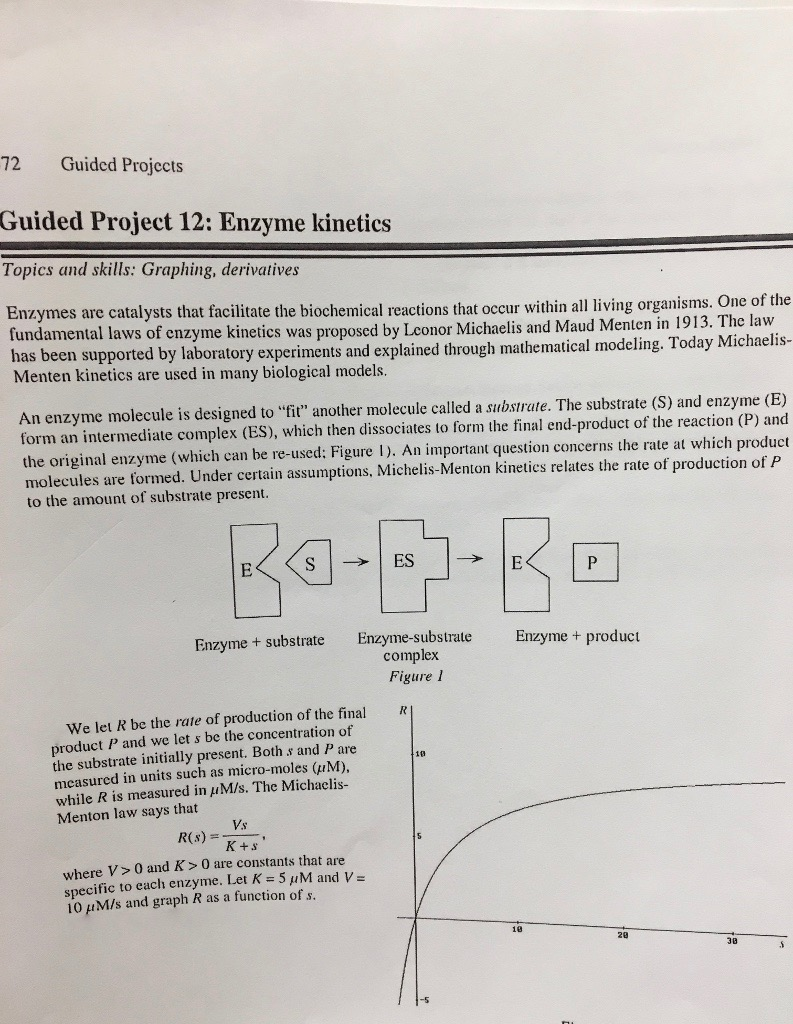
Interpret the constant V and K. Evaluate the lim R(s) as
s approaches infinity. Why is V the maximum production rate? Is
there any value of [s] for which the production rate equals V? How
does the shape of the graph of R change if V is increasing? If V is
decreasing ?
see more
Show transcribed image text 72 Guided Projects Guided Project 12: Enzyme kinetics Topics and skills: Graphing, derivatives Enzymes are catalysts that facilitate the biochemical reactions that occur within all living organisms. O fundamental laws of enzyme kinetics was proposed by Lconor Michaelis and Maud Menten in 1913 has been supported by laboratory experiments and explained through mathematical modeling.1 Menten kinetics are used in many biological models. he ne of t . The law An enzyme molecule is designed to fit" another molecule called a substrate. The substrate (S) and enzyme (E) form an intermediate complex (ES), which then dissociates to form the final end-product of the reaction (P) and the original enzyme (which can be re-used: Figure I). An important question concerns the rate at which product molecules are formed. Under certain assumptions, Michelis-Menton kineties relates the rate of p to the amount of substrate present. roduction of P Enzyme + substrate Enzyme-substrate complex Figure I Enzyme+ product We let R be the rate of production of the final R product P and we let s be the concentration of the substrate initially present. Both s and P are measured in units such as micro-moles (uM), while R is measured in μM/s. The Michaelis- Menton law says that 10 R(s)–Vs- K +s where V>0 and K> 0 are constants that are specific to each enzyme. Let K= 5 μ M and V= 1O HM/s and graph R as a function of s. 10 30 -5
72 Guided Projects Guided Project 12: Enzyme kinetics Topics and skills: Graphing, derivatives Enzymes are catalysts that facilitate the biochemical reactions that occur within all living organisms. O fundamental laws of enzyme kinetics was proposed by Lconor Michaelis and Maud Menten in 1913 has been supported by laboratory experiments and explained through mathematical modeling.1 Menten kinetics are used in many biological models. he ne of t . The law An enzyme molecule is designed to fit" another molecule called a substrate. The substrate (S) and enzyme (E) form an intermediate complex (ES), which then dissociates to form the final end-product of the reaction (P) and the original enzyme (which can be re-used: Figure I). An important question concerns the rate at which product molecules are formed. Under certain assumptions, Michelis-Menton kineties relates the rate of p to the amount of substrate present. roduction of P Enzyme + substrate Enzyme-substrate complex Figure I Enzyme+ product We let R be the rate of production of the final R product P and we let s be the concentration of the substrate initially present. Both s and P are measured in units such as micro-moles (uM), while R is measured in μM/s. The Michaelis- Menton law says that 10 R(s)–Vs- K +s where V>0 and K> 0 are constants that are specific to each enzyme. Let K= 5 μ M and V= 1O HM/s and graph R as a function of s. 10 30 -5
ScholarMatic: Explanation & Answer
Your ready answer from a verified tutor is just a click away for as little as $14.99


Click Order Now to get 100% Original Answer Customized to your instructions!