LAB MODULE: STAINING– STUDY HELP
Instructions: Read the Staining lab document on Late Nite Labs.
Answer the questions on this study help document in preparation for
the Pre-Lab Quiz on Canvas. This document will also help you on
your Late Nite Labs quiz.
Which of the following statements is/are true concerning
bacteria? (For each false statement, know why the statement is
false.)
o It is necessary to stain bacteria because they are
colorless and invisible under a light microscope.
o Heat fixation kills bacteria and makes them adhere to
the slide.
o Scientists only use one stain when staining
bacteria.
List and define the three bacterial shapes.
List the four arrangements of bacteria. (You have three typical
arrangements. Bacteria can also be dispersed individually.)
What characteristic does the Gram method use to distinguish
between Gram-positive and Gram-negative bacteria?
Label each statement as describing Gram-positive bacteria,
Gram-negative bacteria, or both.
o Have thin cell walls that allow ethanol to wash
out the dye-iodine complexes
o Counterstain makes the invisible bacteria pink after
decolorization.
o Have thick cell walls with a high percentage of
peptidoglycan.
o Retain the primary purple stain.
o Look purple after using the Gram method to stain
bacteria.
o Look pink after using the Gram method to stain
bacteria.
For the Gram method:
• What is the primary stain?
• What is the decolorizer?
• What is the counter-stain?
The following picture is Staphylococcus aureus.
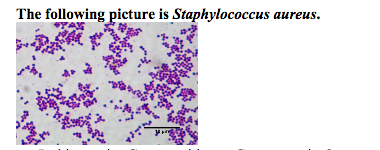
• Is this species Gram-positive or
Gram-negative?
• What is the shape of each bacterium?
• What is the arrangement of the bacteria?
The following picture is Escherichia coli.• Is this
species Gram-positive or Gram-negative?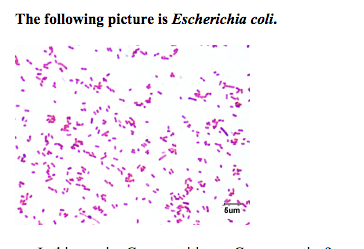
• What is the shape of each bacterium?
• What is the arrangement of the bacteria?
For the Acid-Fast stain method:
• What is the primary stain?
• What is the decolorizer?
• What is the counter-stain?
Which of the following statements is/are true concerning
Acid-Fast staining? (For each false statement, know why the
statement is false.)
o Acid-fast positive bacteria cannot be identified
by Gram staining because their waxy cell walls repel Gram
staining.
o When preparing microscope slides of acid-fast
bacteria, scientists use serum to help cells adhere to the
slide.
o Acid-fast positive bacteria look pinkish purple under
a microscope (after the staining procedures).
o Acid-fast negative bacteria have no color under the
microscope (after the staining procedures).
o The bacterium responsible for tuberculosis is
acid-fast positive.
o The bacterium responsible for leprosy is acid-fast
negative.
For the endospore staining method:
What is the primary stain?
What is the counter-stain?
Which of the following statements is/are true concerning
endospores? (For each false statement, know why the statement is
false.)
o Most bacterial genera produce spores.
o Spore-producing bacteria produce endospores in
response to stress (e.g., lack of nutrients).
o Endospores are more durable than active
bacteria.
o The bacterial species that causes anthrax can produce
spores.
o A scientist must steam a microscope slide in order to
force the primary stain into the spores.
o Scientists have to observe cultures grown for
different lengths of time (e.g. after two days, again after five
days) so that they can observe endospores within bacteria and
released endospores.
Which of the following statements is/are true concerning capsule
staining? (For each false statement, know why the statement is
false.)
o Capsules are found outside the cell wall of some
species of bacteria.
o Capsules are made of mucous and repel aqueous
stains.
o During capsule staining, the capsule resists staining
and appears as a white ring around the cell.
o Heat can cause bacteria to shrink and may make
bacteria appear to have a capsule when they do not.
o Heat can shrink capsules and make them more difficult
to detect.
o Capsules make it harder for bacteria to adhere to
surfaces.
o The capsule prevents phagocytosis of the
bacterium.
o Capsules decrease the ability of bacteria to cause
disease.
Once you answer all of the questions on this study help
document, go to the Staining lab module and submit the Staining
Pre-Lab Quiz.
Then, go to the Late Nite Labs course site and complete all
Staining lab activities.
After you finish the Staining lab activities on Late Nite Labs,
submit the Staining multiple choice quiz on Late Nite Labs.
The following picture is Staphylococcus aureus.
ScholarMatic: Explanation & Answer
Your ready answer from a verified tutor is just a click away for as little as $14.99


Click Order Now to get 100% Original Answer Customized to your instructions!