Look at the following experiments testing the
Intermediate Disturbance Hypothesis. Compare the
results Lubchenko found in the tide pools to those for the rocky
surfaces. Explain what you find. Recall that tidepools have
water at all times. Rocky surfaces are only under water at
high tide. At low tide, they are splashed by waves.
Examine Sousa’s data (table and figure), and explain your
interpretation of his results.
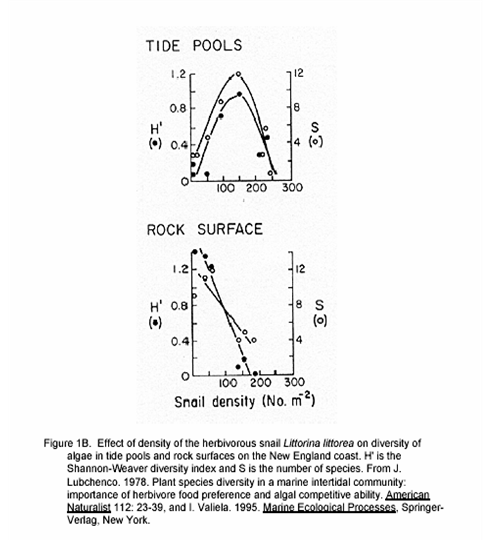
Jane Lubchenco looked at effects of
the herbivorous snail Littorina littorea on diversity of
macroalgae (seaweed) on the New England (MA) coast. She studied
both tidepools in the upper intertidal zone and on surfaces of very
large (immovable) rocks lower down in the low intertidal zone. (The
intertidal zone is the zone between highest and lowest tides).
The research began from visual
observations. In the tidepools, Lubchenco noticed that algal
diversity was different from pool to pool. Some were dominated by
one species (such as the green alga, Enteromorpha
intestinalis) while others supported 10 or more seaweed
species. Snail density also differed between pools. Lubchenco then
conducted 2-way choice laboratory studies on food preferences of
the snails. Enteromorpha was clearly a preferred food
while others such as the red alga, Condrus crispus was
not.
In the field, Lubchenco manipulated
snail density in studies lasting several years. She measured
diversity of seaweed in the pools and on the rock surface and
compared the relationship between snail density and algal diversity
in the two habitats.
Wayne Sousa tested the intermediate
disturbance hypothesis proposed by Connell (1978). In the 70’s and
’80’s ecologists hotly debated factors explaining high diversity in
tropical regions and the deep sea. Popular ideas included: the time
hypothesis (older communities are more diverse), the competition
hypothesis (in agreeable climates where biological and not physical
factors prevail, interspecific competition and niche partitioning
results in high diversity), and the environmental stability
hypothesis (relatively unchanging physical variables allow more
species to exist). Connell questioned all of these and reasoned
instead that highest species diversity exists under conditions of
intermediate disturbance. He proposed that in recently disturbed
communities a few early colonizing species prevail; similarly after
a long time diversity is also low, but these few are long-living
and competitively dominant organisms. Diversity would therefore be
greatest at intermediate points when a variety of species had
colonized a habitat but competitive exclusion had not yet taken
place.
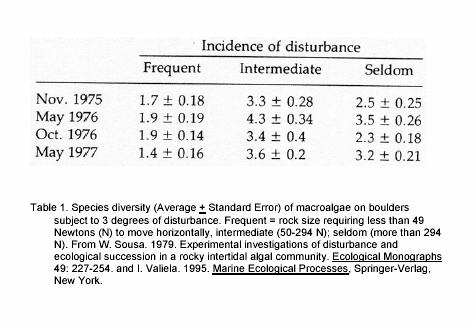
Sousa examined effects of wave
movement on diversity of organisms living on boulders along beaches
in California. In this study Sousa first determined the
relationship between boulder size and force required to move them.
As expected, small boulders moved often, large ones seldom; when
boulders rolled over attached species become damaged or dislodged.
Measurement of various sized boulders therefore allowed Sousa to
examine a gradient of disturbance frequency and intensity. To
measure the force necessary to move boulders of different sizes
Sousa pulled boulders with a chain attached to a spring scale; he
pulled in the direction of incoming waves and converted the
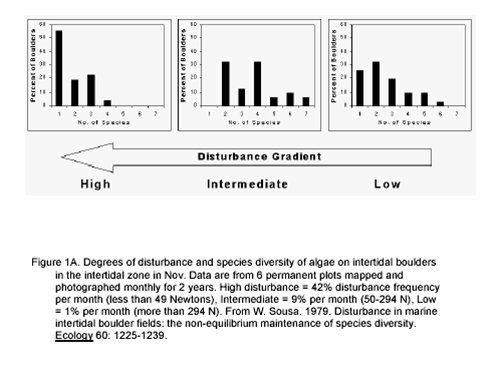
measured dislodging force from kilograms to Newtons (N). The figure
below comes out fuzzy no matter what I do. Here are the axis
labels.
The figure below comes out fuzzy no matter what I do. Here are
the axis labels.
In the figure below, the axes on the graphs are
x= number of species
y = percent of boulders
TIDE POOLS 12 0.8 100 200 300 ROCK SURFACE 12 H’ 0.8 00 200 300 Snail density (No. m2) Figure 1B. Effect of density of the herbivorous snail Littorina littorea on diversity of algae in tide pools and rock surfaces on the New England coast. H’ is the Shannon-Weaver diversity index and S is the number of species. From J. Lubchenco. 1978. Plant species diversity in a marine intertidal community importance of herbivore food preference and algal competitive ability. Amencan Naturalist 112: 23-39, and I. Valiela. 1995 Verlag, New York.
ScholarMatic: Explanation & Answer
Your ready answer from a verified tutor is just a click away for as little as $14.99


Click Order Now to get 100% Original Answer Customized to your instructions!